
Princeton City Directory Holdings
The Princeton Public Library Local History Resource Guide is the central inventory for historical Princeton listings. It distinguishes the library's printed directories, three reels of microfilm, and selected years in a licensed database. That distinction matters. A year visible in a catalog is not necessarily a public scan, and a missing online year may still be available on a reader in the Princeton Room. The guide verifies the existence, dates, organization, and access paths for these series. An individual scanned Princeton directory entry was not examined during the research, so the collection inventory should not be mistaken for a transcription of any person's listing.
| Collection | Coverage | Keeper | Access route |
|---|---|---|---|
| Printed Princeton directories | About 1916-17 through 1982, with gaps | Princeton Room, Princeton Public Library | Ask at the second-floor desk about the needed year |
| City Directories of the United States, Princeton | 1901-1935 on three reels | Princeton Public Library microform | In-library reader; images may be printed, emailed, or saved |
| HeritageQuest Princeton directories | 1901-15; 1919; 1921-28; 1931-36; 1938-42; 1947; 1949-50; 1952; 1954-55; 1957-58 | Library-licensed database | Remote use for eligible library cardholders |
| Community, suburban, and criss-cross books | Selected years from 1961 through 2016, depending on series | Princeton Public Library | Reference and physical holdings; confirm title and year |
Public guide metadata does not identify the annual print-directory publisher or imprint for every Princeton volume. The microform is cataloged as City Directories of the United States, Princeton; HeritageQuest is the digital host; and Hill-Donnelly and InfoUSA appear as criss-cross title variants. A title page or catalog record is the right place to verify a particular volume's imprint. Missing years are a coverage limit, not proof that a household arrived or left Princeton in that gap.
The library's Princeton Room feature shows the local-history setting behind the directory holdings.
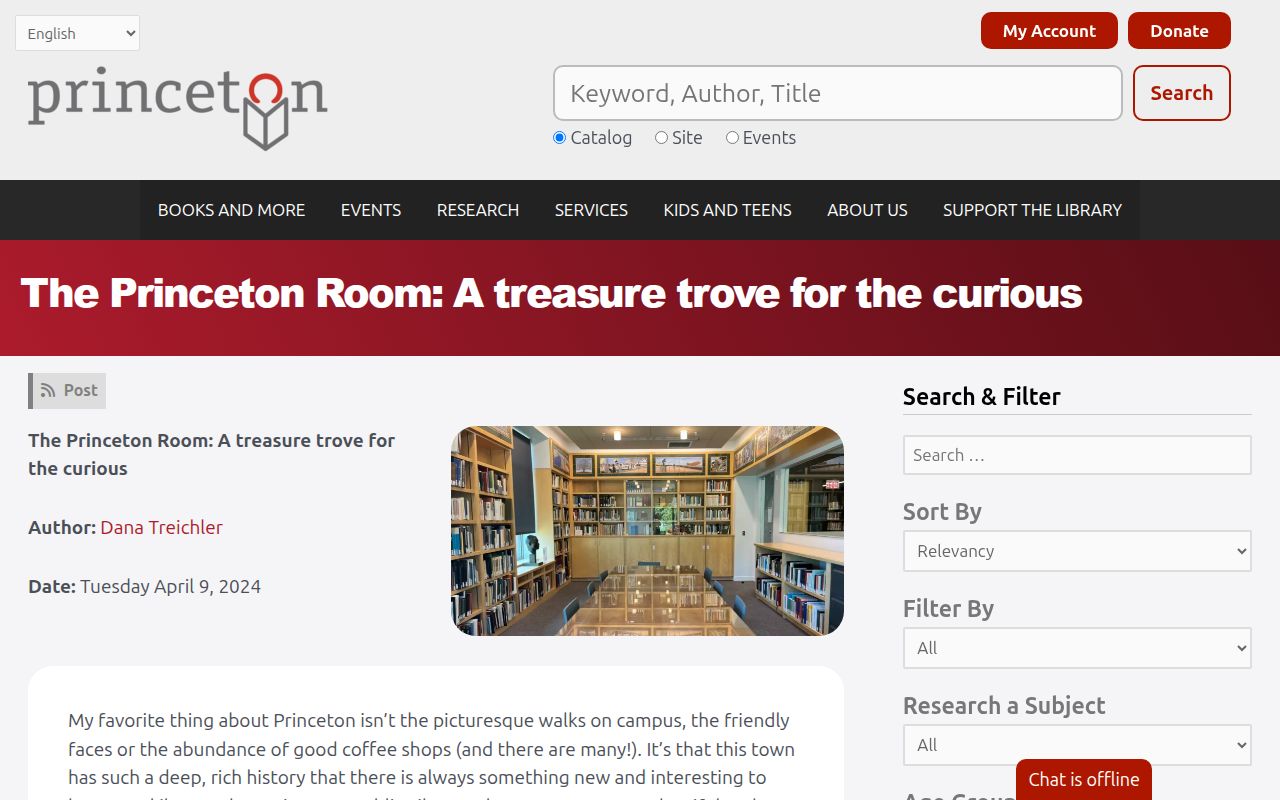
The room joins directories with maps, census material, local newspapers, vertical files, and genealogy resources, which makes it practical to test a dated listing against another historical source.
The Historical Society of Princeton's major collections overview documents family papers, photographs, oral histories, architecture, and community material that can add context after a directory year is established.
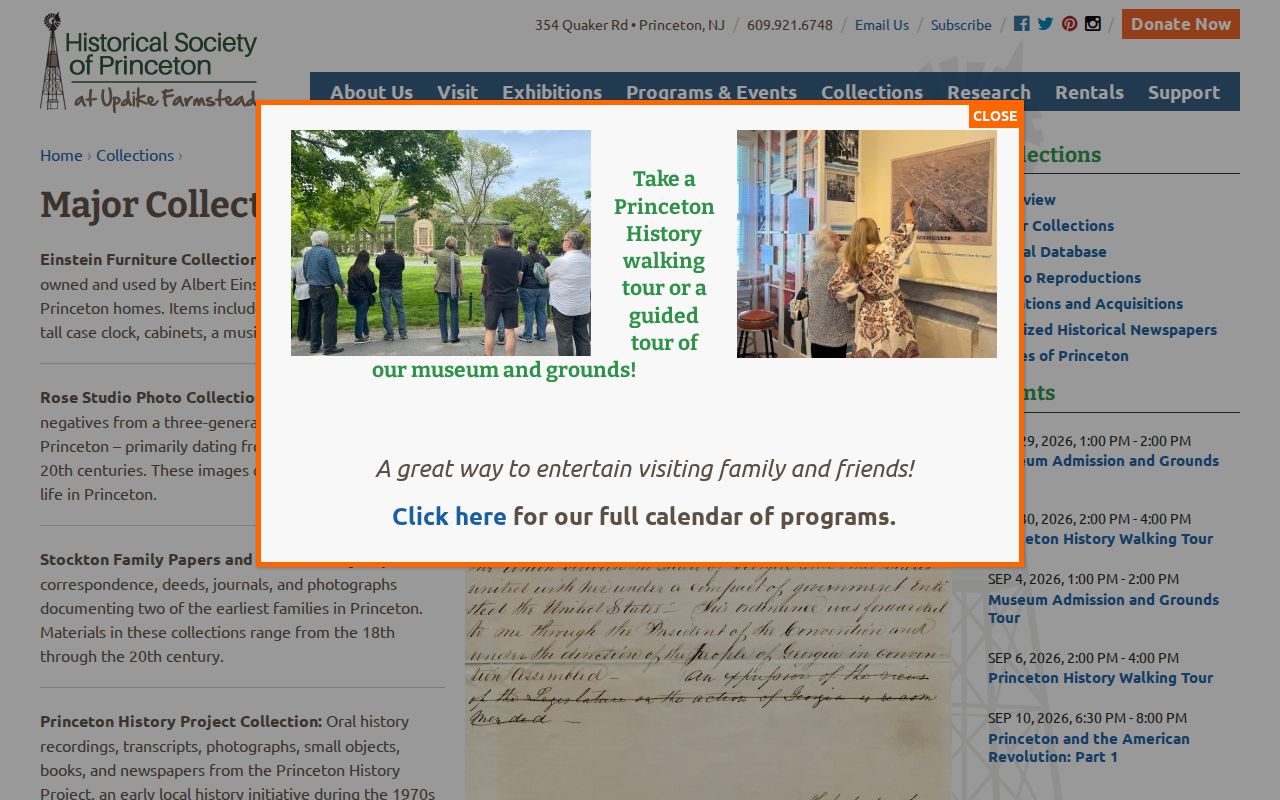
Those materials can support a historical association, but they do not turn a dated address listing into evidence of current residence.
Princeton Directory Desk and Phone Books
The Princeton Room is on the library's second floor at 65 Witherspoon Street. Its reference contact is refstaff@princetonlibrary.org, and the second-floor information desk is 609-924-9529 ext. 1220. Ask for the precise year, person or street spelling, and whether the needed item is print, microfilm, or a licensed database. Microfilm is available for library use but is not loaned through interlibrary loan. The reader can print, email, or save an image, so a careful citation can include the title, year, page or reel, and the condition of the source.
Phone-book holdings broaden the date range but need equally careful labels. Princeton Community Phone Books are listed for 1961, 1963-1989, 1997-2001, and 2003. Yellow Book Princeton is listed for selected 2009-16 years. Princeton & Suburban Trenton books appear for 1979, 2010, 2011, 2013, 2015, and 2016. The latter may include Bordentown, Ewing, Mercerville, Trenton, Allentown, Cranbury, Hightstown, Hopewell, Lambertville, Lawrenceville, Pennington, and Plainsboro. A Princeton-looking entry can therefore belong to another municipality in the volume.
- Criss-cross directory
- A reverse directory arranged by street address or telephone number rather than a conventional surname listing. Princeton holdings include Hill-Donnelly and InfoUSA variants, with local years to be confirmed at the desk.
- Householder index
- An index that groups a property or address around the listed household. Whether a particular volume supplies one must be checked in that volume.
- Abbreviation key
- The volume's own explanation of shortened terms. Photograph or note it before interpreting a historical listing, because notation varies by publisher and year.
A printed name, street, telephone, role, or relationship belongs to the source year. Capture only information actually printed and relevant to historical or civic research. Treat an address as a publication-era listing, not continuous occupancy.
Princeton Historical Images and Inquiries
The Historical Society of Princeton's digital image database has nearly 4,000 photographs, although only part of the larger holdings can be searched there. It offers keyword and advanced search tools, categories for people, landmarks, institutions, and events, and a “Click & Search” term list. Search an address or street only after checking its period spelling and the relevant municipal name. A returned photograph proves the captioned subject and date as recorded by the collection; it does not establish a current household at that address.
The HSP digital database provides the searchable entry point for this visual collection.
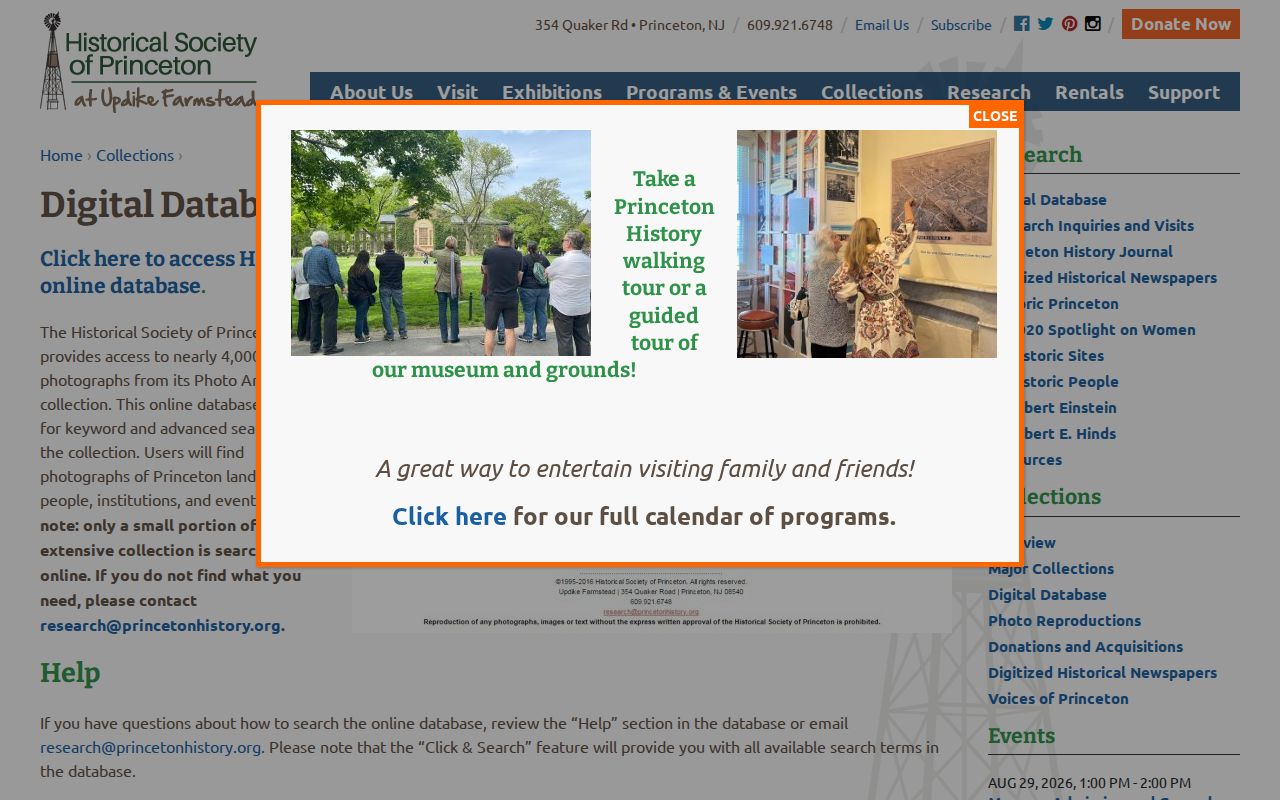
Pair an image caption with a dated directory, newspaper, deed, or map before drawing a historical location conclusion.
For material outside the online search, HSP accepts an online research inquiry. The form asks for identity and contact information, a topic, summary, reason for research, and representation details. The research notes report that the first 30 minutes were free on the then-current page, followed by $20 per hour, with separate copy and appointment rules. Confirm the fee and turnaround with HSP before submitting, because access policies can change.
HSP's research inquiry form is the documented route for a focused collection question.
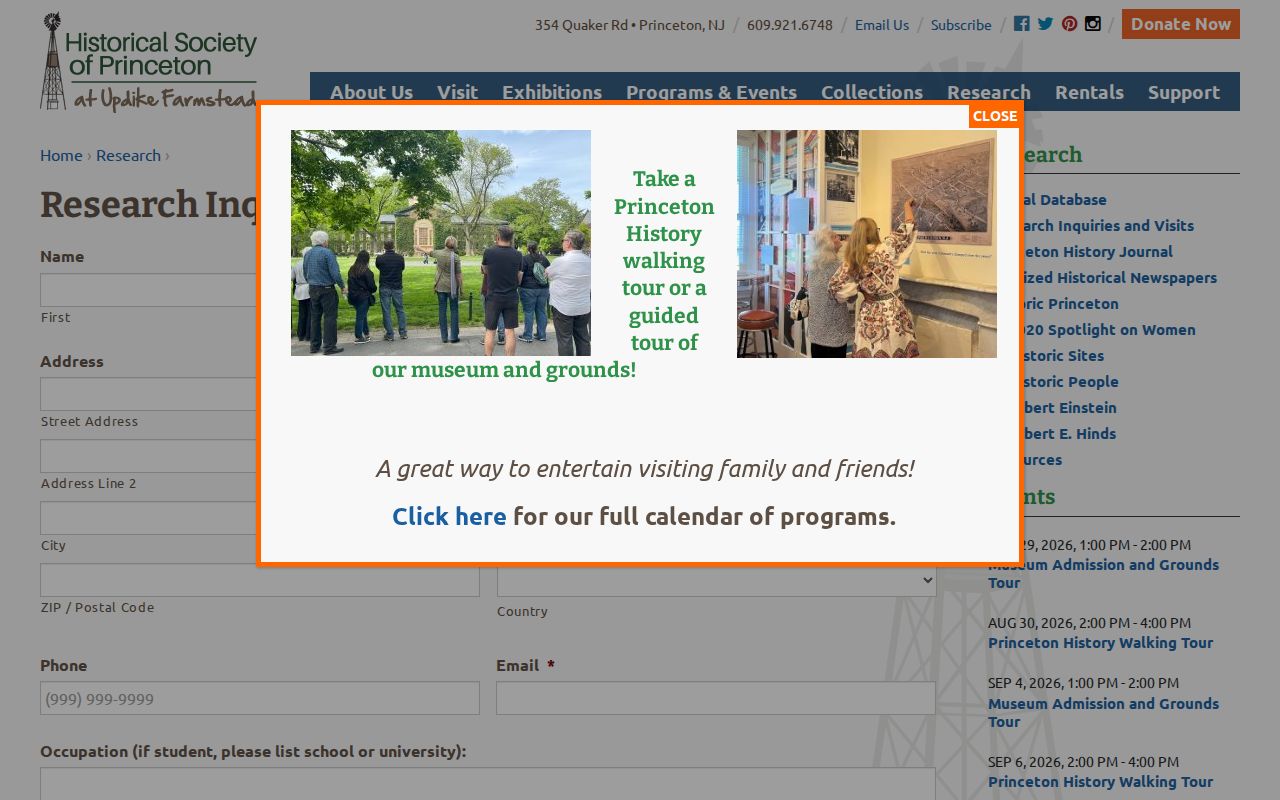
A narrow request, such as a particular street, organization, date range, or collection name, is easier for a custodian to evaluate than an open-ended request for all information about a person.
Princeton Directory Dates in Newspapers
Directory dates can be checked against the library's newspaper microfilm when a move, organization, death notice, address change, or public event needs a dated source. The Princeton Packet run starts July 12, 1839 and continues through 2022 with gaps and title changes. The guide also lists Princeton Herald from November 1923 to December 1966, Princeton Recollector from May 1975 to Autumn 1986, Town Topics from March 17, 1946 to December 20, 2009, and Woman's Newspaper of Princeton from April 6, 1982 to December 1991. Search by title, issue date, and page, and record whether an item is a notice, paid notice, or article.
Papers of Princeton offers online discovery for digitized publications, while the Historical Society lists additional publication coverage. HSP records Daily Princetonian from 1876-2015, Local Express from 1935-39, Nassau Literary Review from 1842-2015, Princeton Herald from 1928-66, Princeton Recollector from 1975-86, and Town Topics from 1946-2013. Coverage varies by platform. A newspaper reference is a historical statement with its own editorial and factual limits, not a current-residence claim.
| 1901-1935 | The library's three directory microfilm reels provide the earliest documented Princeton city-directory run in this set. |
|---|---|
| About 1916-17 to 1982 | Printed Princeton directories continue the library shelf record, with missing years that must be noted. |
| 1961-2003 | Princeton Community Phone Book holdings supply selected later listing years, separated by several gaps. |
| 2009-2016 | Selected Yellow Book Princeton and Princeton & Suburban Trenton volumes offer later public-listing context, with broader regional coverage in the suburban series. |
These dates describe documented collection runs, not a continuous annual chronology. A person, business, or street may appear in one source and disappear in the next because the publisher changed, the collection lacks a year, the listing practice changed, or the source used another municipality label. Preserve the gap before comparing a name across the timeline.
Princeton University Library's Sanborn map feature explains how to begin with an index sheet before selecting the town or site sheet.
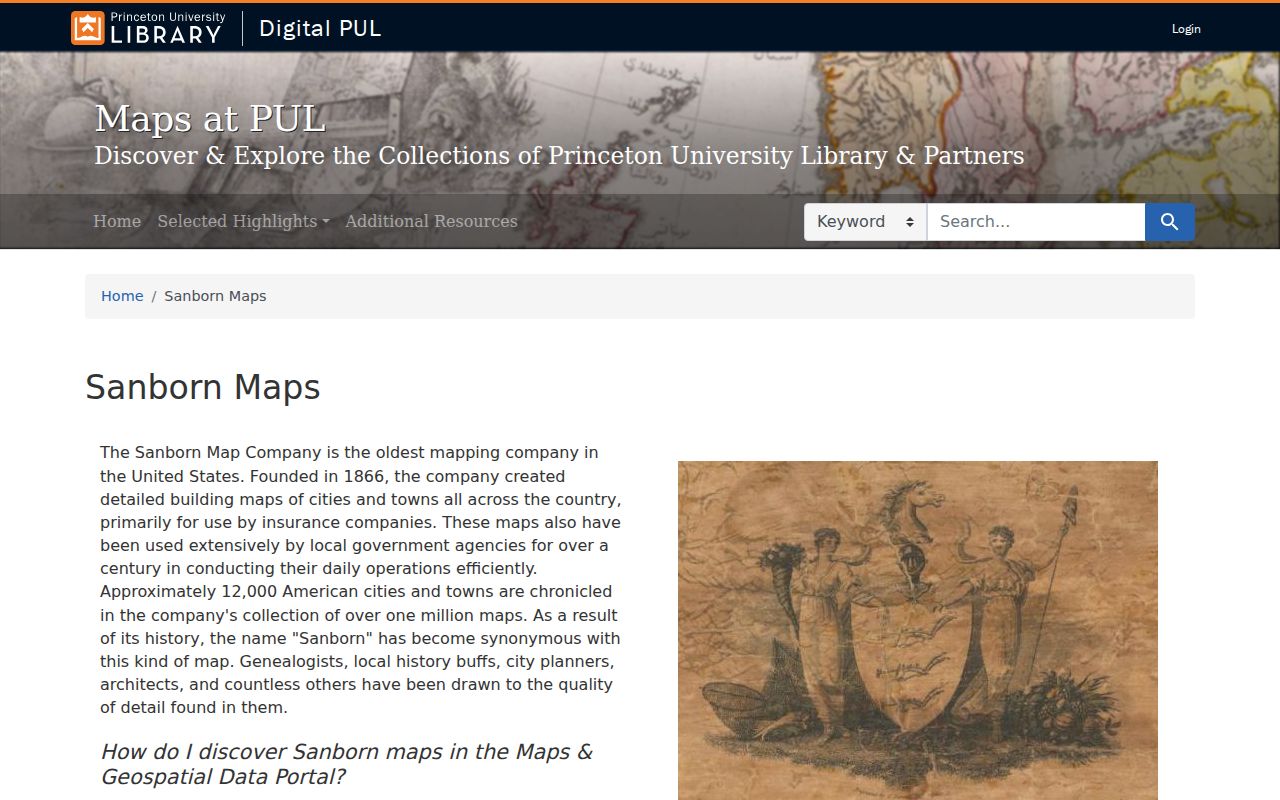
Sanborn maps were made for insurance and local-government use. They can orient a historical street or structure, but they are not evidence of present occupancy and should be cited by sheet and date.
Tracing Princeton City Directory Years
A cautious name trail uses at least two dated anchors. The directory establishes what was printed in one publication year. A census, map, newspaper, probate record, cemetery record, or historical collection can then test the date, municipality, or family connection. New Jersey state censuses occur in selected years from 1855 through 1915, and federal census releases follow their own time rule. Preserve the enumeration year and geography rather than treating a household record as timeless.
- Choose a target year and write the name, initials, street spelling, and municipality variant exactly as known.
- Check the print shelf, microfilm sequence, or HeritageQuest list for that year. Record a gap rather than silently substituting a different year.
- Transcribe the actual entry with title, publication year, page or reel, and any unreadable text. Do not add facts from memory or a later source.
- Use a nearby directory year and an appropriate census or newspaper issue to test whether a similar name refers to the same historical person.
- For a street question, consult a criss-cross volume only when its year and arrangement are confirmed, then label every result as a dated listing.
Keep the original date on every note. Princeton's old Borough and Township context, nearby-community telephone books, and changing street references can all affect a match. The strongest conclusion is modest and specific: a named source listed a person or address in a stated year, subject to the source's coverage and legibility.